
Last updated on September 30, 2026
TL;DR: Finseo in 30 seconds
- Finseo is an AI visibility tool from Germany: it sends your questions to ChatGPT, Gemini, Google AI Overviews and other models every day and reports whether your brand is named or your site is cited as a source.
- Prices as of 30 September 2026: Starter €84, Business €210, Growth €479 a month, or €70, €175 and €399 on yearly billing. Every plan includes three models of your choice and unlimited users.
- The catch: the task list, attribution and crawlability checks only start with Business. The Starter plan measures but does not tell you what to do.
- We have used Finseo ourselves since September 2026, for ecom-tools.de and for client projects at our agency. The measurement is strong; the automatically generated tasks are partly spot-on and partly off the mark.
- On data protection it is good without reservation: Finseo GmbH from Gaildorf, hosting in Frankfurt, a data processing agreement on every plan.
- Our rating: 4.1 out of 5. The most thorough measuring tool for AI answers in the German-speaking market, with points off for price, an English-only interface and contradictory figures in its own documentation.
- Try it yourself: test Finseo for seven days*. If you just want a first look, start with the free AI visibility check, which needs no sign-up.
People looking for a product increasingly ask an AI instead of a search engine. The answer is no longer a list of ten links but a paragraph with three recommendations. If you are in it, you get the visitor. If you are missing, you never find out, because Google Analytics does not show you the answers you were left out of.
Finseo is one of the tools that make exactly this visible. It puts your questions to the major AI models every day, reads the answers and counts how often your brand is named and how often your site is cited. The company is based in south-west Germany, hosts in Frankfurt and has changed its pricing structure twice since our first article.
Our first Finseo article was written in July without access to the tool. We now work with it. This review is based on two weeks of tracking for ecom-tools.de and on client projects at our agency. We show what Finseo measures, what it costs in 2026, how useful the automatic tasks are and who the whole thing is worth it for.
Our rating: 4.1 / 5
The most thorough measuring tool for AI answers in the German-speaking market: daily queries against real user interfaces, a clean split between mention and citation, the full text of every answer, and a German company hosting in Frankfurt. Points off for the price, because the most useful modules only unlock at €210, for an interface that speaks English only, for task suggestions of varying quality, and for plan details that contradict each other on the company’s own website.
| Tracking & data quality | ★★★★½ 4.6 |
| Analytics & reports | ★★★★☆ 4.4 |
| Actions & agent | ★★★½☆ 3.8 |
| Value for money | ★★★½☆ 3.5 |
| Data protection & provider | ★★★★½ 4.8 |
| Usability & documentation | ★★★½☆ 3.7 |
🔍 Rated with our 5-criteria framework – every score can be recalculated.
* Affiliate link: if you sign up through it, we earn a commission. The price stays the same for you.
What is Finseo?
Finseo belongs to a category of tools that did not exist two years ago. The industry calls them GEO tools, after Generative Engine Optimization, sometimes AEO or LLMO. It always means the same thing: measuring and improving how a brand appears in the answers of AI assistants. A classic SEO suite shows you positions in a results list. Finseo shows you whether you are mentioned in a piece of running text that a machine has only just put together.
Behind it is Finseo GmbH from Gaildorf in Baden-Württemberg, registered at the Freiburg district court. It was founded in 2025 by David Mühlenweg, who is listed as managing director in the imprint, and Maurice Marinelli. By its own account the company has grown without investors, is profitable and has more than 500 customers, among them Kellogg’s, Panasonic, Würth and Lidl. The customer count and the profitability cannot be checked from outside; the reference logos are on the website.
The ambition goes beyond measuring. Finseo wants to cover the whole loop: measure first, then check whether AI crawlers can reach your site at all, then improve content, and finally prove how much revenue came from AI answers. How far that carries depends heavily on the plan.
How we tested
Since 17 September 2026 ecom-tools.de has had its own Finseo project with 30 prompts on three models: ChatGPT, Google AI Overviews and Gemini. In the first two weeks Finseo analysed 1,144 AI answers for it. On top of that come client projects that we manage as an agency in the same account.
The screenshots in this article come from an anonymised client project at our agency. The project name, the account and every detail that could point to the client are covered. The figures for ecom-tools.de in the text come from our own project. We also pull the data through the MCP interface Finseo provides for AI assistants.
What Finseo measures
The smallest unit is the single AI answer: one prompt, one model, one day. One prompt on three models produces about 90 answers a month. That is why the Starter plan with 50 prompts contains roughly 4,500 answers. Finseo stores each of them in full, together with the sources the model gave.
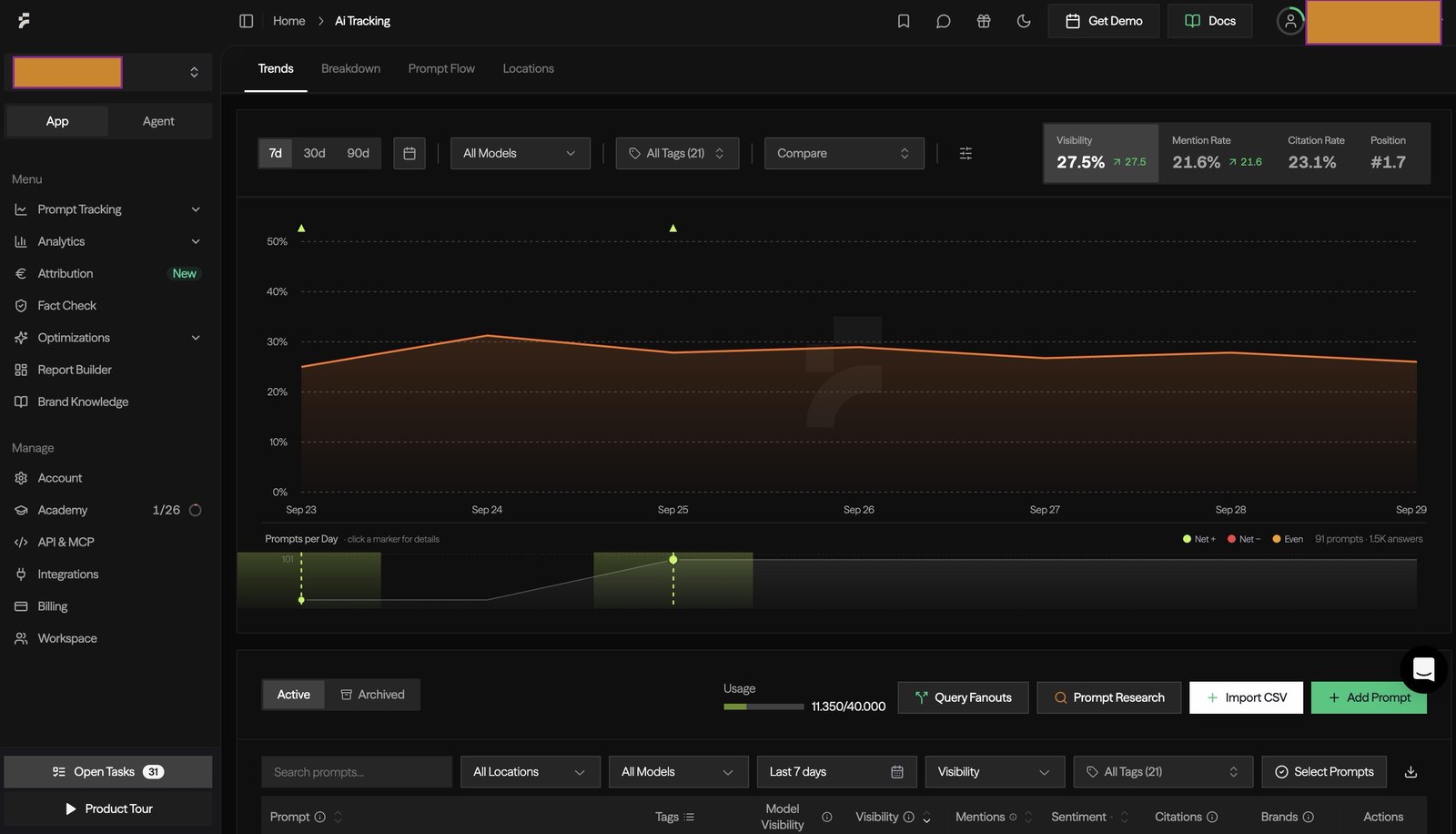
The overview in Finseo: visibility, mention rate, citation rate and position over seven days, with usage of the answer quota below. Anonymised client project at our agency.
From the answers Finseo calculates a handful of metrics that complement each other:
| Metric | What it tells you |
|---|---|
| Visibility | Share of answers in which the brand is named or its own domain is cited as a source |
| Mention rate | Share of answers carrying the brand name in the text |
| Citation rate | Share of answers linking to the brand’s own domain |
| Position | Average rank among all brands named in an answer |
| Share of voice | Own mentions relative to the mentions of all brands |
| Sentiment | Tone from 0 to 100, broken down by topics such as price, quality or support |
Finseo only introduced the split between mention and citation in September 2026, and for sites like ours it is the decisive point. ecom-tools.de reached 5.9% visibility in the first two weeks. Of that, 5.8 points came from citations and only 1.5 from mentions. The AI models use our reviews as evidence but rarely name us. For a store it is usually the other way round: what matters there is whether the brand is recommended. Without this split we would have drawn the wrong conclusion from the total.
Which AI models Finseo queries
On the standard plans you choose three models that run in parallel. According to the pricing page there are ten to pick from: ChatGPT, Gemini, Google AI Overviews, Google AI Mode, Claude, Perplexity, Microsoft Copilot, Grok, DeepSeek and Mistral. Further models can be added and each brings its own answer quota. For China, South Korea and Brazil there are regional services such as Qwen, Naver AI Briefing or Sabiá, which Finseo only sets up together with its own team.
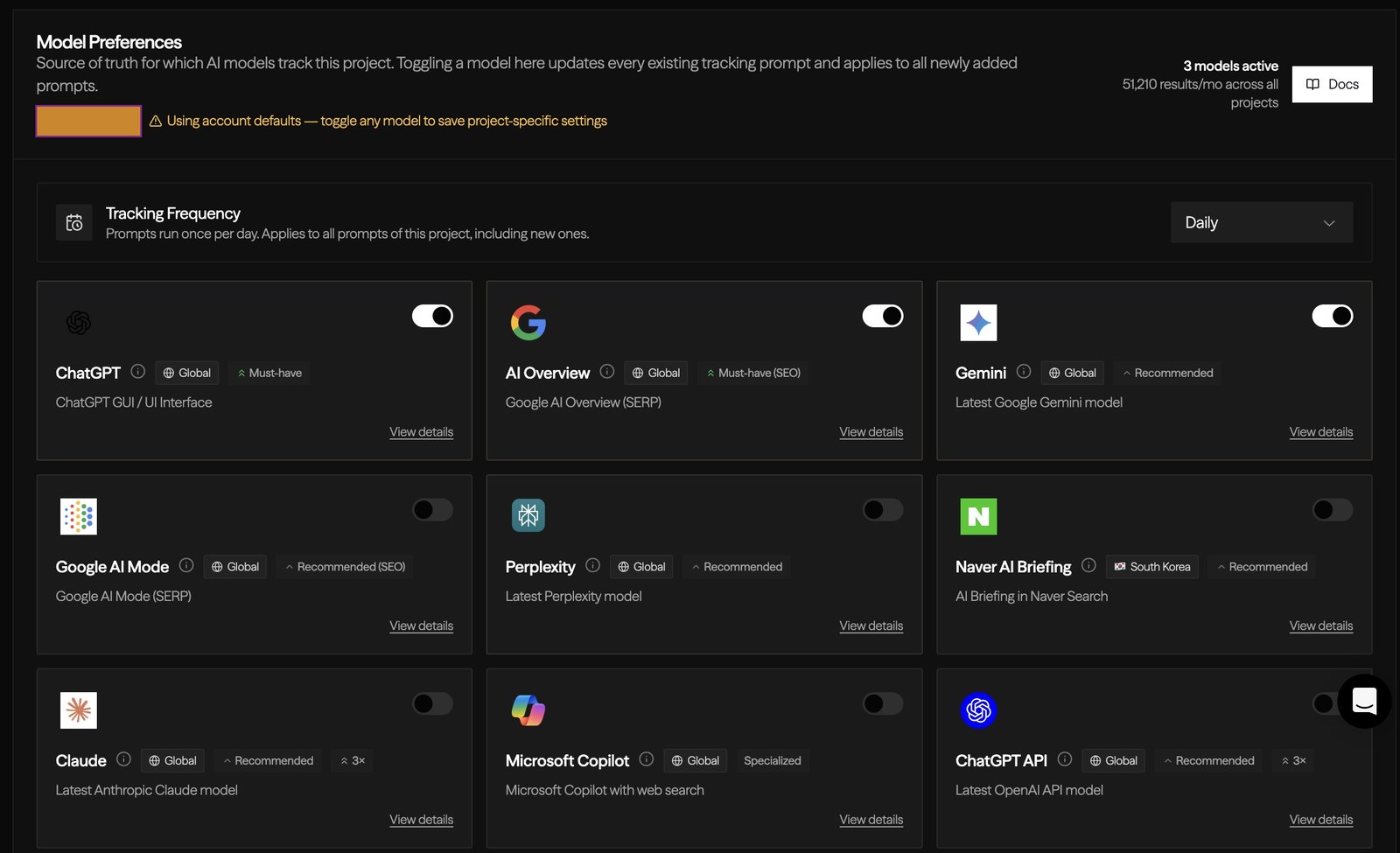
The model settings: three models active, queried daily. Claude and the ChatGPT API carry a “3×” marker. Anonymised client project at our agency.
One detail sets Finseo apart from some competitors: where possible, the tool says it queries the models’ real user interface and not the programming interface. That matters because the ChatGPT interface with web search answers differently from the API. Where no interface is accessible, as with Claude, Finseo uses the official API.
In our account Claude and the ChatGPT API carry a “3×” marker. The documentation does not explain it. The obvious reading is that these models count three times against the answer quota. If you want to enable them, ask support first what that means for your plan.
The most important features
The most valuable thing day to day is the look into the individual answer. For each prompt Finseo shows the history per day and model, the full wording and the list of sources. That is how we saw how Gemini describes our site: as a specialised portal for the German-speaking market that tests tools against fixed criteria. That wording comes almost verbatim from our methodology page. No metric gives you that kind of insight; you have to be able to read the text.
The source analysis shows which pages the models draw on most. In our project that was 2,613 different sources. At the top was our own English review of a niche tool, with 80 citations. For the big questions about the best tools for online sellers, by contrast, almost only ranked lists with a year in the title were cited, from vendors and agencies. That gave us a concrete editorial plan.
The query fan-outs reveal which sub-questions a model breaks a request into before it answers. ChatGPT turned a question about Shopify apps into several searches with “2026” and “Germany” added. If you want to know which wording to aim your content at, this is the most direct answer. We know this view from no classic SEO suite.
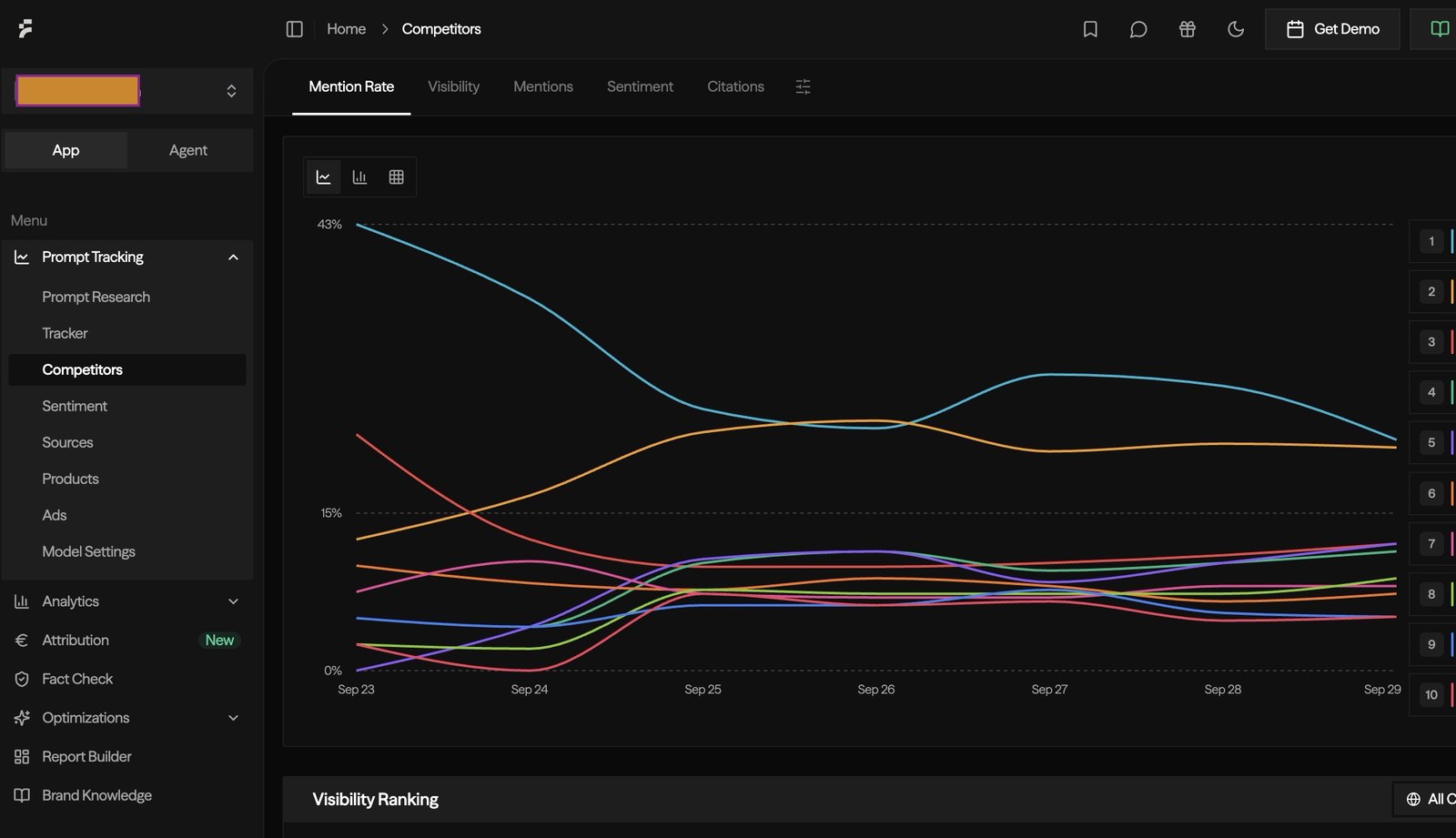
The competitor view compares mention rate, visibility, tone and citations over time. We cropped out the legend with the brand names. Anonymised client project at our agency.
The competitor analysis calculates visibility, position and the head-to-head comparison, meaning who is named first when both brands appear in the same answer. It has one quirk you need to know: as long as no competitors are entered, Finseo counts every brand that turns up in the answers. In our project Shopify, YouTube and Google therefore topped the list, although our actual competitors are other review portals. This can be configured, but it does not happen by itself.
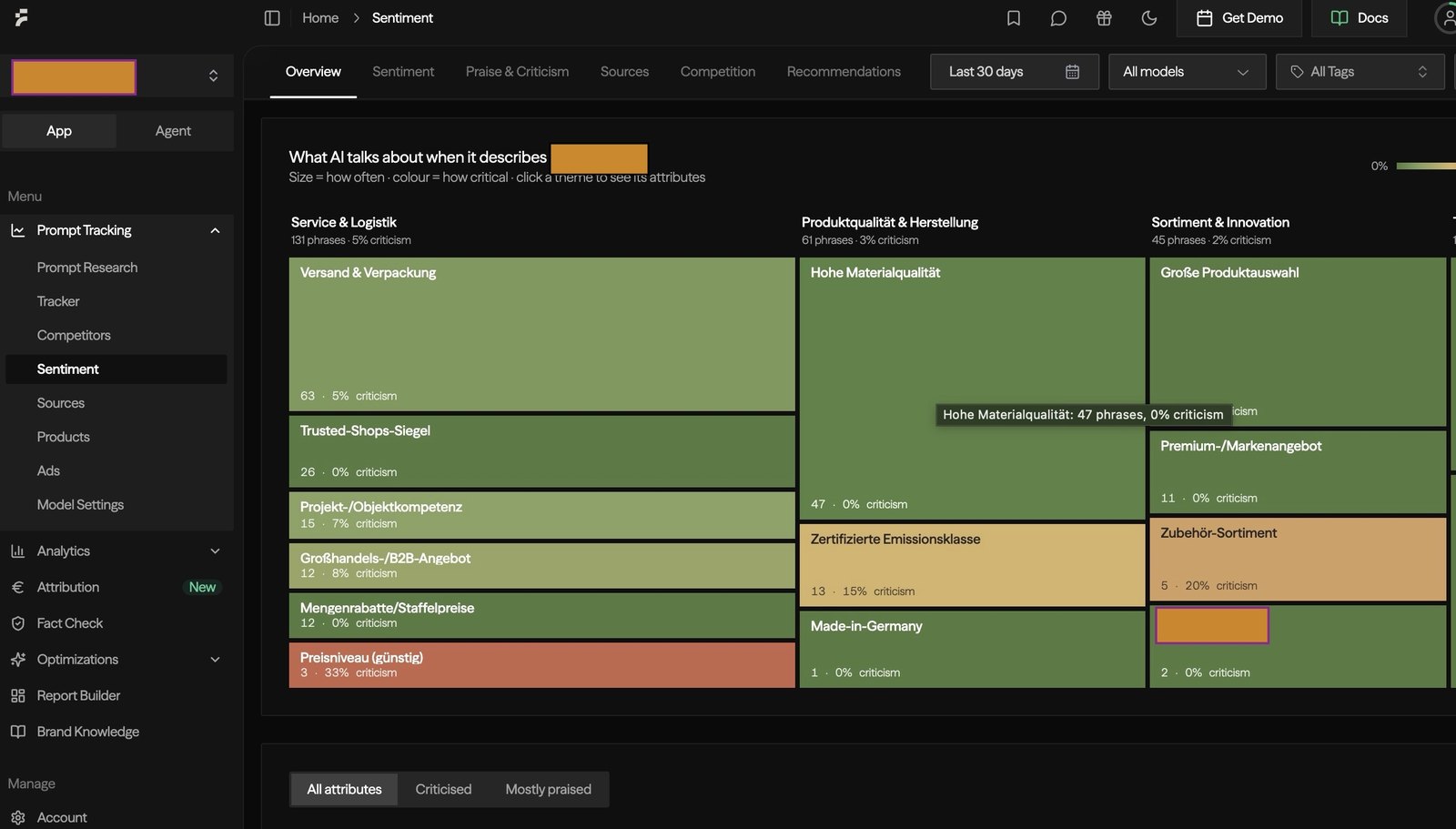
The sentiment overview shows what the AI talks about when it describes a brand. Tile size stands for frequency, colour for the share of critical statements. Anonymised client project at our agency.
For stores the sentiment view is the most tangible. It shows which attributes the models ascribe to a brand, such as shipping, material quality or price level, and how often criticism comes with them. In the client project shown it was quickly clear that the AI is more reserved about price than about quality. That is a statement a store owner can work with.
Then there are modules we do not yet use ourselves and therefore only describe: prompt research with suggestions from Search Console, shopping and ads tracking for product recommendations in AI answers, bot analytics for visits from GPTBot and other crawlers, attribution of orders to AI sources via Shopify, WooCommerce, Shopware or Stripe, and a report builder for white-label reports.
Tasks and agent
From the Business plan, Finseo turns the measurement data into a prioritised task list. Each task has a category, a priority and the evidence it was derived from. It can be handed over to Jira, Asana, ClickUp or Notion.
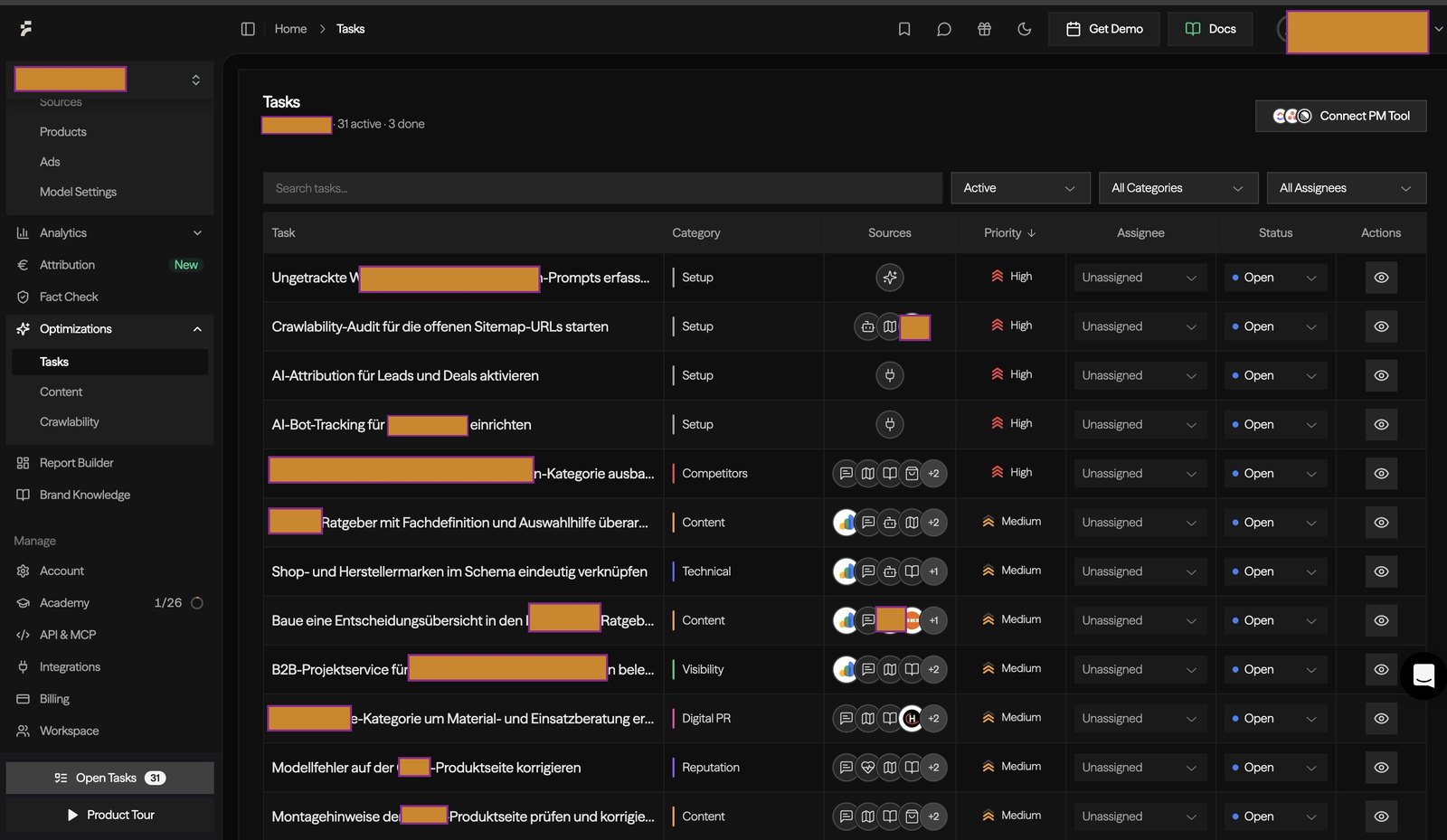
The Tasks page: tasks with category, sources, priority and status. The interface is English; the tasks themselves arrive in German for German projects. Anonymised client project at our agency.
Our experience with it is mixed. Of 25 tasks for ecom-tools.de, some were exactly right: add a decision matrix to our supplier guide, extend the tool finder with an FAQ, start the crawlability check. Others missed the point. Finseo recommended that we create a company profile for review portals and build our own discussion hub. Both went back to prompts that had nothing to do with our site. The tasks are only as good as the prompts they come from.
One task we gladly accepted: Finseo recommended that we rework our own Finseo article. You are reading the result.
The Finseo Agent goes a step further. It researches prompts, writes articles and can push changes straight into WordPress, Webflow or Framer. It is paid for with credits: an article costs 500, a crawlability check 35. The Business plan includes 7,500 credits a month, Starter only 300 for trying it out. We have not let the agent loose on our own pages and therefore do not rate it.
What Finseo costs
Finseo has separate price lists for brands and for agencies. All prices exclude VAT. On yearly billing the monthly price drops by about a sixth, and the year is charged in advance.
| Plan | Price per month | Scope | What is missing |
|---|---|---|---|
| Starter | €84, yearly €70 | 50 prompts, 3 models, about 4,500 answers, 1 project, MCP access, 300 agent credits, 7 days free | no tasks, no attribution, no crawlability check, no bot analytics |
| Business | €210, yearly €175 | 150 prompts, about 13,500 answers, 1 project, tasks, attribution, bot analytics, 7,500 credits | no API, one project only |
| Growth | €479, yearly €399 | 350 prompts, about 31,500 answers, 5 projects, API and webhooks, 25,000 credits, priority support | no SSO, no dedicated contact |
| Enterprise | on request | up to 11 models, unlimited projects, SSO, setup by Finseo, optionally as a managed service | oversized for a single store |
Every plan includes unlimited users, daily queries, competitor and source tracking, and MCP access. According to the pricing page, the seven-day trial applies to the Starter plan only.
Starter measures, Business acts
The Starter plan at €84 delivers all the metrics but no task list, no crawlability check and no attribution. Those modules are exactly what sets Finseo apart from pure measuring tools. If you want them, you pay €210 a month. For a young store that is a lot of money for a topic that today accounts for only a small share of traffic. The honest way in for most is therefore: book Starter, measure for two or three months, and only then decide whether the jump is worth it.
A worked example: a store wants to watch 25 questions in each of two markets on ChatGPT, Gemini and AI Overviews. That is 50 prompts times three models times 30 days, so 4,500 answers, which is exactly the Starter plan. Per prompt that costs €1.68 a month. Add a fourth model or grow the list to 60 prompts and the next plan is due.
For agencies there are separate packages: Solo at €349 with five client projects and 20,000 answers, Studio at €599 with ten projects and 40,000 answers. Each additional answer costs 1.5 cents. The minimum term here is six months. In return, white-label reports, the API and free 14-day pitch projects are included.
The third pricing structure in a short time
Earlier versions of this article already documented two other price lists: first plans at $19 and $49, then in summer 2026 Creator at €99, Business at €189 and Enterprise from €499. Now the entry plan is called Starter, costs €84 and includes twice as many prompts as the old Creator plan. The middle plan has become €21 more expensive and includes 150 prompts instead of 100.
Per prompt, Finseo has become cheaper. Even so, the sequence shows that the pricing model has not yet settled. If you sign a yearly plan, you commit to today’s state. In the terms of service we found no rule on how Finseo handles price changes for existing customers.
Where Finseo’s own figures contradict each other
Comparing the primary sources, we noticed several inconsistencies. None of them is serious on its own. Together they show that the copy is not keeping pace with the product:
- The plan card lists 150 prompts and 13,500 answers for Business; the FAQ on the same page says 100 prompts and 9,000 answers.
- Growth covers five projects according to the plan card, three according to the FAQ.
- The yearly toggle advertises a 15% saving; the listed prices work out at just under 17%.
- The API documentation still lists the old plan structure with Creator (25 prompts) and Business (100 prompts).
- According to the FAQ all integrations are included on every plan, but the comparison table strikes CMS, project management and attribution from Starter.
When in doubt, what the checkout says applies. For the figures in this article we followed the plan cards and Finseo’s own fact page, which both show the same state.
Data protection and provider
Here Finseo has a clear advantage over most competitors. The contracting party is a German GmbH with a complete imprint, commercial register number and VAT ID. According to the provider, the data is stored in Frankfurt. A data processing agreement under GDPR is available on request on all plans according to the pricing page, as is payment by invoice. A trust centre listing the security measures is linked from the website.
Two caveats: the terms of service are an English standard document dated September 2025. We found nothing specific in them on the trial, automatic renewal or price changes. And Finseo by nature processes the answers of third-party AI services, most of which are based in the US. Personal data of your customers is not involved as long as you do not set up attribution. If you link orders to AI sources, sign the agreement first.
Finseo for online sellers
For a store, three things are interesting. First, the question of whether your brand appears in buying advice, that is, for prompts like “best running shoes for wide feet”. Second, the shopping analysis, which shows which products a model recommends, at what price and from which retailer. Third, attribution, which assigns an order from Shopify, WooCommerce or Shopware to the AI source the buyer came from.
To get started there is a free AI visibility check on the Finseo website. It needs no sign-up, only your site’s address and an email address, and shows in about a minute how the major models classify your brand. It does not replace tracking, but it is enough for a first assessment.
To be frank: if you are only just starting, you do not need Finseo yet. A store with no content of its own, no reviews and no mentions on other sites will not appear in AI answers, and you can predict that without a tool. At that stage the money is better spent on product pages, guides and reviews. Finseo becomes useful once a brand has some recognition and you want to know whether the work on your content is landing.
What works well day to day
Getting started is quick: enter the domain, choose models, add prompts. In our project the first answers arrived a few minutes after the prompts were created. After that the queries run daily without anyone having to trigger anything, and every answer stays readable in full.
We found the MCP interface especially useful. It lets you query the project data from Claude or ChatGPT in plain language. Much of the analysis for this article was done that way: metrics, prompt list, sources and tasks came back in structured form without anyone exporting spreadsheets. Access is included on every plan. It is read-only, though: prompts, tags and competitors cannot be created through it; that works only in the interface or through the API from the Growth plan.
Development is fast, too. The public API changelog lists for September 2026 alone the new visibility definition, the mention rate and citation rate metrics, and pitch projects for agencies. Finseo does not publish a product roadmap. The documentation announces as “coming soon” that the agent will also be able to optimise Shopify stores.
Where the limits are
The biggest trap is the prompt list. After a bulk import our project contained 20 new prompts, twelve of which had nothing to do with our site, among them a Dutch search query and a question about a brokers’ forum. Finseo queried them daily for two weeks, counted them into every metric and derived tasks from them. The tool does not check whether a prompt fits the brand. If you do not review the list yourself, you end up measuring something other than you think.
The interface is available in English only. Menus, metrics and help texts are English; only the generated tasks come in German. For a German company with a German website that is surprising. Explanations are also missing in many places: what the “3×” marker means or how position and mention depth differ is only in the documentation, which is English as well. Users on OMR Reviews criticise exactly that.
Then there is the variation in the answers. The same question to the same model returns different brands on two days. That is down to the models, not to Finseo, and the company says so openly. But it means a single day’s value says little. A number only becomes reliable over two or three weeks and across a prompt list of reasonable size. With the 50 prompts of the Starter plan spread over two markets it already gets thin.
Finally, price relative to benefit. AI answers today bring most stores a single-digit share of their visitors. If you spend €210 a month on that, you should know what you will do with the results. Without someone to carry out the tasks, Finseo remains an expensive thermometer.
What users say about Finseo
The data is thin. On OMR Reviews Finseo stands at 5.0 out of 5 from 15 reviews; the exact value is 4.97. The sub-scores shine less: ease of use 90%, customer support 89%, setup 90%, each just below the category average. Only on meeting requirements does Finseo sit above it, at 94%.
Praise goes to the intuitive operation, the fast support and the concrete recommendations. Criticism targets missing documentation, unexplained terminology and a steep learning curve for anyone who does not come from SEO. That matches our impression.
On Trustpilot the profile is claimed but contains not a single review. Finseo itself also cites 5.0 out of 5 on G2. We could not retrieve that page during our research, so we can confirm neither the score nor the number of reviews. Fifteen reviews are in any case too few to derive a reliable verdict.
Finseo compared with the alternatives
| Tool | Entry plan | Middle plan | Better than Finseo if |
|---|---|---|---|
| Finseo | €84, 50 prompts, 3 models | €210, 150 prompts | – |
| Peec AI | €85, 50 prompts, 3 models | €205, 150 prompts, 2 projects | you need two projects on the middle plan or watch many countries |
| Otterly.ai | $29, 15 prompts, 4 models | $189, 100 prompts | you want to start cheaply with a few prompts |
| Seobility | €59.90, SEO suite with AI Overview tracking | €99.90 | you mainly need classic SEO and only want to keep an eye on AI answers |
Peec AI is the most direct competitor and almost identical on price, right down to the same prompt tiers. Otterly.ai has the lowest entry at $29, though with only 15 prompts, and charges extra for Gemini, Claude and Google AI Mode. Seobility is a different kind of tool: an SEO suite that tracks Google AI Overviews within its rank monitoring and has announced tracking for ChatGPT and Gemini. For many small stores that is the more sensible first step.
Then there are the add-on modules of the big suites, from Semrush and Ahrefs for example, and Profound for large corporations. Finseo differs from this field through its German seat with hosting in Frankfurt, the querying of real user interfaces, and the attempt to bundle everything from measurement to revenue attribution in one tool. Prices are list prices from 30 September 2026 excluding VAT.
Who Finseo is right for
Finseo fits if your brand already has content, reviews and some recognition and you want to know how AI assistants talk about it. It fits agencies that offer GEO as a service and need evidence for it. And it fits companies whose procurement requires a German contracting party with a data processing agreement.
Finseo does not fit if your store has only just gone live, because then there is nothing to measure yet. It does not fit if there is nobody to translate the results into content. And it does not fit if you need an interface in German or if €84 a month is too much for a pure measuring tool.
Our verdict
Finseo makes visible what otherwise stays in the dark, and does so more thoroughly than the add-on modules of classic SEO suites. In two weeks it showed us three things we did not know before: that AI models cite our reviews without naming us, that our methodology page is the source of the few mentions, and that we lack ranked lists with a year in the title for the big questions. That changed our editorial plan.
Against that stand a price that is high for beginners, an interface that leaves explanations owing, and a company that develops faster than it updates its copy. Our 4.1 out of 5 is the grade for a very good measuring tool that knows its craft and is not yet finished at the edges.
Try Finseo yourself
The Starter plan can be tested free for seven days: 50 prompts on three models of your choice, with competitor and source tracking. Add the prompts yourself and review the list after the first day. If you only want a first assessment, use the free visibility check, which needs no sign-up.
* Affiliate link: if you sign up through it, we earn a commission. The price stays the same for you.
Frequently asked questions about Finseo
How much does Finseo cost per month?
Starter costs €84 a month, Business €210 and Growth €479. On yearly billing it is €70, €175 and €399 per month. Enterprise and Managed Service are available on request. For agencies the Solo and Studio packages cost €349 and €599 with a six-month minimum term. All prices exclude VAT, as of 30 September 2026.
Is Finseo free?
There is no permanently free plan. According to the pricing page, the Starter plan can be tested free for seven days. Finseo also offers a free AI visibility check that needs no sign-up and shows in about a minute how the major AI models classify a brand.
Which AI models does Finseo track?
On the standard plans you choose three out of ten models: ChatGPT, Gemini, Google AI Overviews, Google AI Mode, Claude, Perplexity, Microsoft Copilot, Grok, DeepSeek and Mistral. Further models can be added. Finseo sets up regional services for China, South Korea and Brazil on request. Enterprise customers can track up to eleven models in parallel.
What is the difference between visibility, mention rate and citation rate?
Visibility is the share of AI answers in which a brand is named or its domain is cited as a source. The mention rate counts only answers carrying the brand name in the text, the citation rate only those linking to the brand’s own domain. Finseo has reported the three values separately since September 2026. For stores the mention usually matters more, for guide and review sites the citation.
Is Finseo GDPR-compliant?
The contracting party is Finseo GmbH from Gaildorf, registered at the Freiburg district court. According to the provider, the data is stored in Frankfurt. A data processing agreement is available on request on all plans according to the pricing page, as is payment by invoice. The terms of service are available in English only.
Is Finseo worth it for small online stores?
Not yet for a store that is only just starting. Without its own content, reviews and mentions on other sites a brand does not appear in AI answers, and you do not need a measuring tool to know that. Finseo becomes useful once the brand has some recognition and you want to check whether your content is landing in ChatGPT, Gemini or the AI Overviews. For the beginning the free visibility check is enough.
Is Finseo available in German?
The website is available in German, the application itself in English only. Menus, metrics and the documentation are English. The automatically generated tasks appear in German for German-language projects. Prompts can be created in any language and analysed for more than 40 countries.